
Learn “What is Vibratory Hammer” from a Manufacturer!

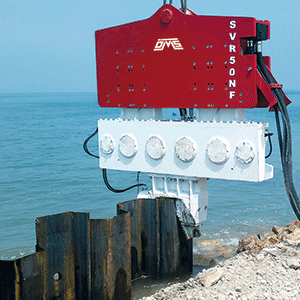
What is Vibratory Hammer and How Does It Work?
As a vibratory hammer manufacturer, in this article we will explain what a vibro hammer is and how it works.
Everyone knows the concept of vibration. In its simplest form, vibration can be described as the oscillation or repetitive movement of an object around an equilibrium point. The word originates from the Latin word “vibrationem,” meaning “shaking” or “brandishing.” Understanding vibration makes it easier to understand the working principle behind vibratory hammer technology.
Before going into technical details, it is important to understand what a pile hammer is, where it is used, and the advantages it provides.
What is a Vibratory Hammer?
A vibratory hammer is a machine used for driving or extracting sheet piles, tube piles, and similar foundation elements into or out of the ground. These machines are commonly used in the construction of bridges, harbors, roads, airports, canals, and various infrastructure projects.
Compared to traditional impact pile drivers, vibratory hammers offer several important advantages. Traditional systems use heavy impact weights to strike the pile repeatedly, while vibratory hammers use vibration technology, resulting in quieter and faster operations. They are also more compact, lightweight, environmentally friendly, and suitable for underwater applications. In some models, vibration levels can be fully controlled, making them ideal for use in residential areas or near historical structures where vibration sensitivity is critical.
Vibro hammers operate by using rotating eccentric counterweights that generate vibration. These vibrations reduce soil resistance by changing the soil structure and minimizing friction between the pile and the surrounding ground. The vibratory piling machine transfers vertical vibrations to the pile through a hydraulic clamp. As vibration spreads into the soil, the soil temporarily behaves in a liquefied state, allowing the pile to be driven or extracted with significantly less force. As a result, the pile advances into the ground through the combined effect of the machine’s own weight and the centrifugal force produced by the vibrator.
Main Components of a Vibro Hammer
The main components of a vibratory hammer system are:
-
Vibration Suppressor
-
Vibration Case
-
Hydraulic Clamp
-
Power Unit
Vibration Suppressor
The vibration suppressor assembly is mounted on top of the vibration case. Its purpose is to isolate vibration from the crane or carrier equipment while also supporting pile extraction operations.
Vibration Case
The vibration case contains high-amplitude eccentric weights that rotate vertically to generate vibration. These eccentric weights are integrated with gears and are driven by hydraulic motors mounted directly on the vibration case. All motors and eccentric systems are gear-connected to ensure proper synchronization during operation.
The eccentric shafts and motor shafts are mounted on heavy-duty cylindrical bearings. Lubrication of gears and bearings is provided through the radiator system located in the power unit. Oil pumps circulate oil continuously between the vibration case and radiator, helping reduce oil temperature and maintain system performance.
Hydraulic Clamp
The hydraulic clamp is the component responsible for gripping the pile or tube. It contains two gripping jaws: one fixed and one movable. The movable jaw is controlled by a hydraulic cylinder located inside the clamp body. Additionally, the clamp includes a safety check valve that keeps the jaws closed during emergency situations.
Power Unit (Hydraulic Power Pack)
Vibratory hammers are powered through hydraulic power systems. In excavator-mounted vibratory hammers, the excavator itself acts as the power source. In crane-suspended systems, a separate hydraulic power pack is connected to the hammer using hydraulic hoses.
Inside the power unit there is a diesel engine that drives hydraulic pumps and creates the hydraulic pressure required to operate the vibratory hammer. The diesel engine is mounted on a tubular frame that also functions as a fuel tank. Emergency stop buttons are also integrated into the machine for operational safety.
Features and Advantages of Vibratory Pile Drivers
Vibratory pile drivers are widely used in the construction of harbors, bridges, airports, buildings, railways, roads, solar power plants, wind turbine foundations, retaining walls, and many other infrastructure projects. They are especially suitable for driving sheet piles, pipe piles, and wooden piles.
One of the most significant advantages of vibratory pile drivers is their lower sound level compared to impact hammers. Impact hammers are extremely noisy because they rely on heavy striking forces. Vibratory hammers, on the other hand, are lighter, faster, and do not require excessive impact force on the ground. For this reason, they are much more suitable for urban areas and city-center projects.
OMS Technology
Vibro Hammer Production Process
[/av_textblock]